Reducing Cognitive Load: The Engineering Behind the Epoch Suite
January 27, 2026 · 8 min read
- Productivity
- Tooling
- Performance
- Browsers
Modern development environments are noisy. Between the IDE, the terminal, and the browser, an engineer constantly context-switches across different visual architectures, input models, and latency profiles.
The default Firefox new tab experience introduces work before work: sponsored tiles, remote content, and background requests compete with the simple task of typing a URL. Measured over a day, that friction compounds into real latency and attention loss.
Epoch Suite is an opinionated interface layer for Firefox. The objective is to reduce cognitive and interaction latency for the open‑tab, execute‑query loop while preserving privacy and reproducibility.
1. Epoch Focus: The <20ms Time‑to‑Interactive Constraint
The target for Epoch Focus, the new tab module, is a time to interactive (TTI) of under 20 ms on a typical development laptop. That constraint drives every architectural decision:
- No frameworks: implemented in vanilla JavaScript (newtab.js). No virtual DOM and no hydration.
- No network calls: quotes, icons, and static assets are bundled; the render path is bounded by disk I/O.
- Explicit privacy schema: the manifest declares no data collection. No analytics pipeline or background parsing.
In practice, the browser only needs to load a static HTML shell, one JavaScript file, and a small CSS file. On a warm cache, the limiting factor is the browser’s own process scheduling rather than extension logic.
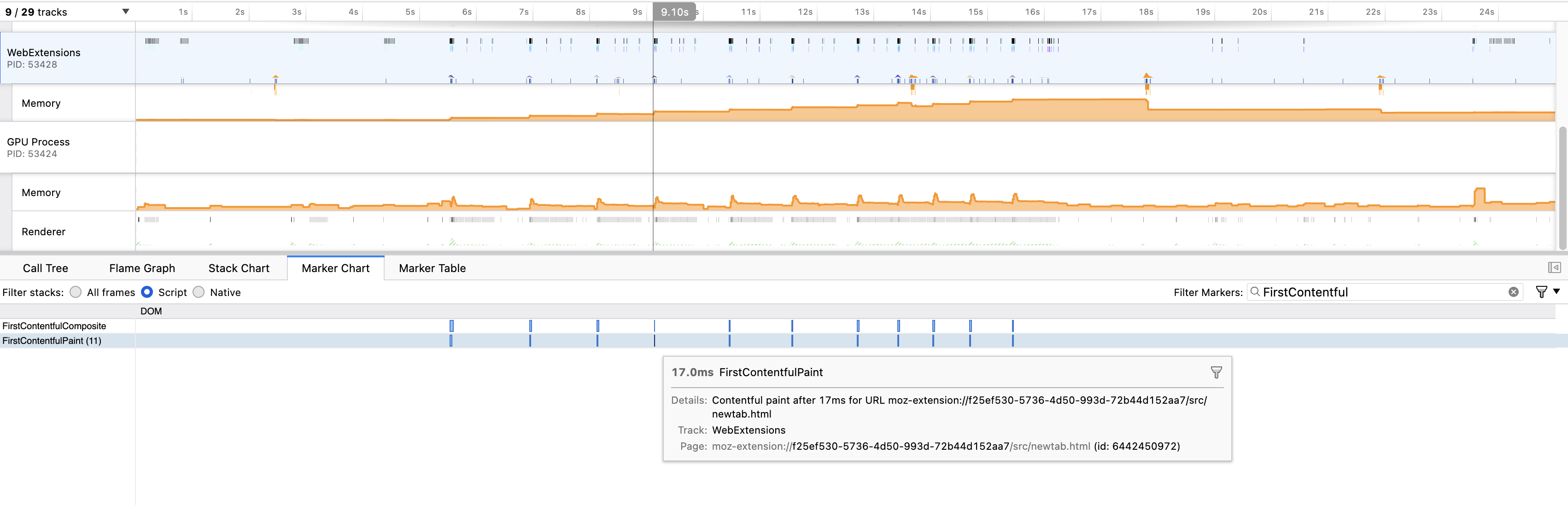
Firefox DevTools: New Tab Call Tree
To validate the sub‑20 ms TTI target, Epoch Focus is profiled with Firefox DevTools using the performance call tree, verifying that critical‑path work is limited to layout, paint, and a small JavaScript initialization frame.
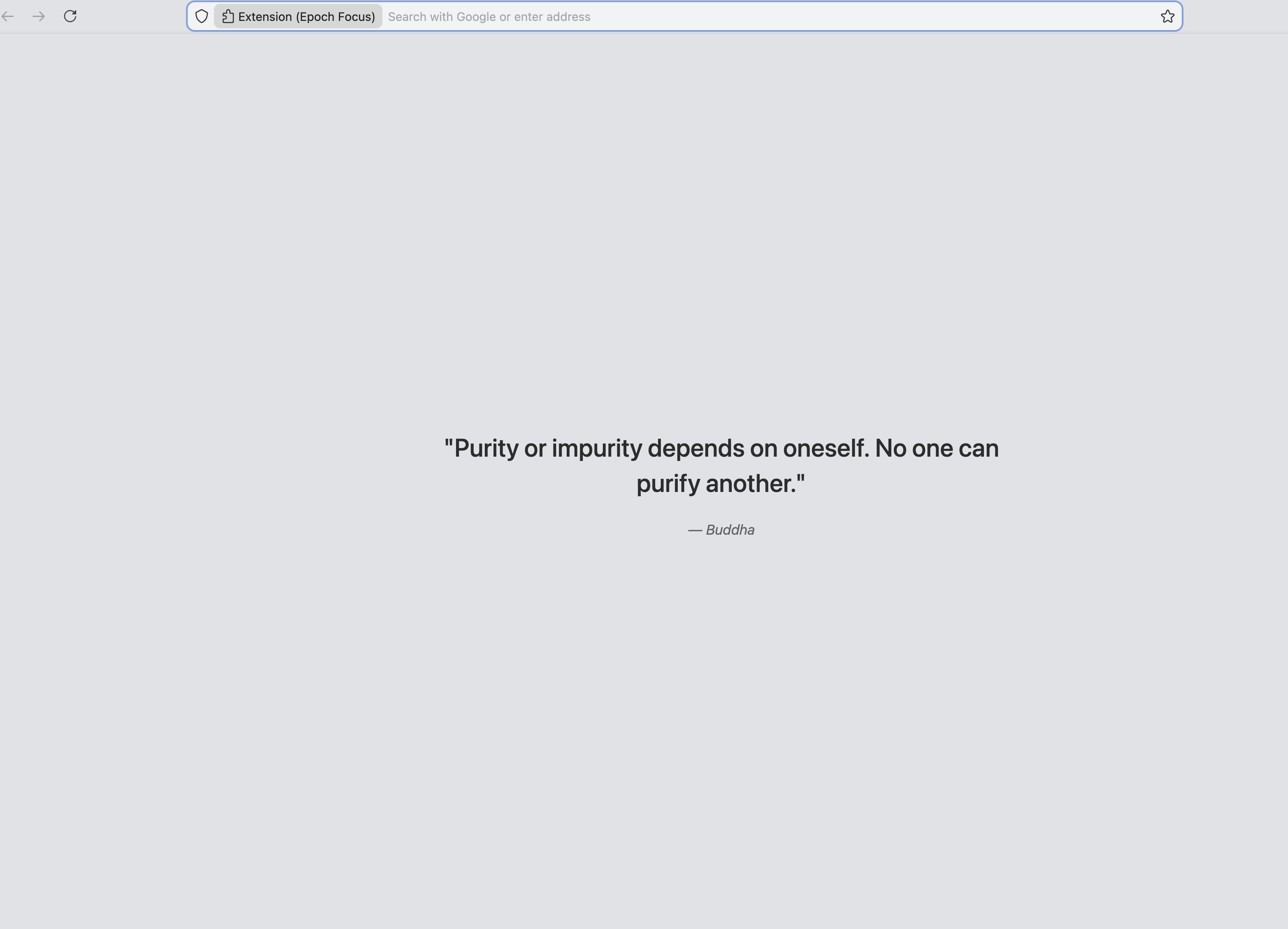
Epoch Focus New Tab Surface
The surface reduces visual noise to a single query field, date‑time indicator, and a small set of context tiles, matching the low‑latency interaction model.
2. Epoch Light: Designing for Visual Latency
Visual latency—the time it takes for the eye to adapt to large contrast jumps—is costly for frequent switches between a dark terminal and a bright browser surface.
Most light themes use near‑pure white backgrounds (#FFFFFF). Epoch Light uses a low‑saturation paper gray (#E0E2E5) chosen to reduce perceptual jolts when moving from a dark window to the browser.
The theme is treated as a software artifact rather than a static design:
- Palette definitions live in a small configuration module, not inlined across assets.
- Background textures and graphics are generated with Python (Pillow, Lanczos resampling) for deterministic outputs.
- Builds are designed so a given commit hash yields identical PNG and SVG outputs for a given platform.
This approach ensures visual adjustments can be treated like code changes: versioned, reviewable, and reversible.
3. Extending the Epoch Protocol
The browser is one component in a larger toolchain. If the new tab is quiet but the editor and terminal are not, overall cognitive load remains high.
- VS Code: theme and syntax highlighting aligned with Epoch Light palette and contrast ratios.
- Sublime Text: color scheme and UI configuration matching the same luminance profile.
- iTerm2 / Zsh: terminal color presets keeping foreground and background levels consistent with the browser surface.
The end state is a unified stack where the browser, editor, and terminal behave like components in a single interface system rather than unrelated applications.
4. Current State and Next Steps
Epoch Suite consists of a shipped Firefox extension and a light theme with deterministic assets. Core constraints are in place: sub‑20 ms TTI for new tabs, no remote calls on load, and a palette tuned for low contrast jumps.
Next steps: standardize configuration across editors and terminals, expose a small public schema for themes, and publish benchmark results for latency and contrast changes across the stack.
Resources
Epoch Focus — View source on GitHub
- Epoch Light — theme and asset set for low visual latency.
- Source code and build scripts for asset generation and packaging.